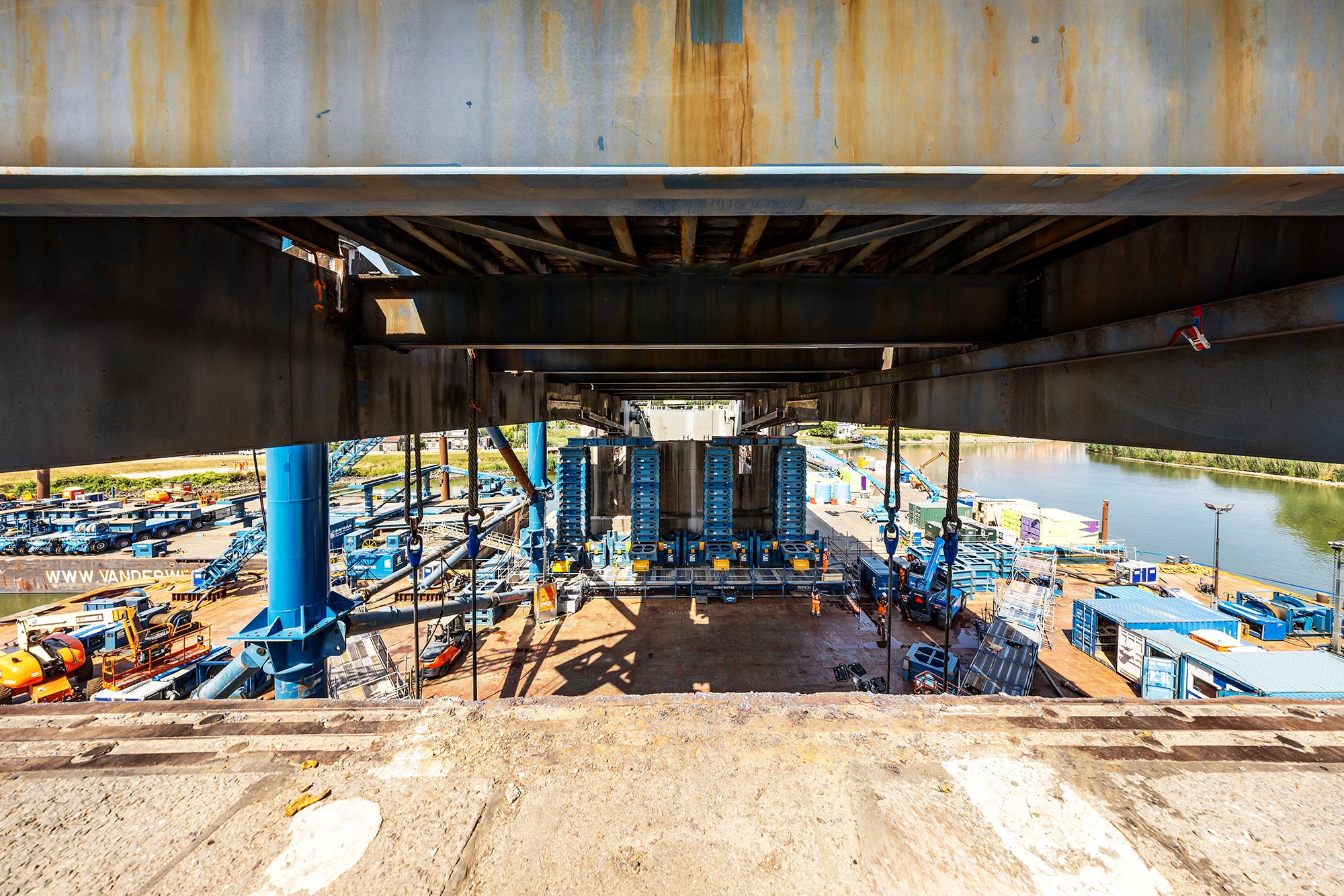
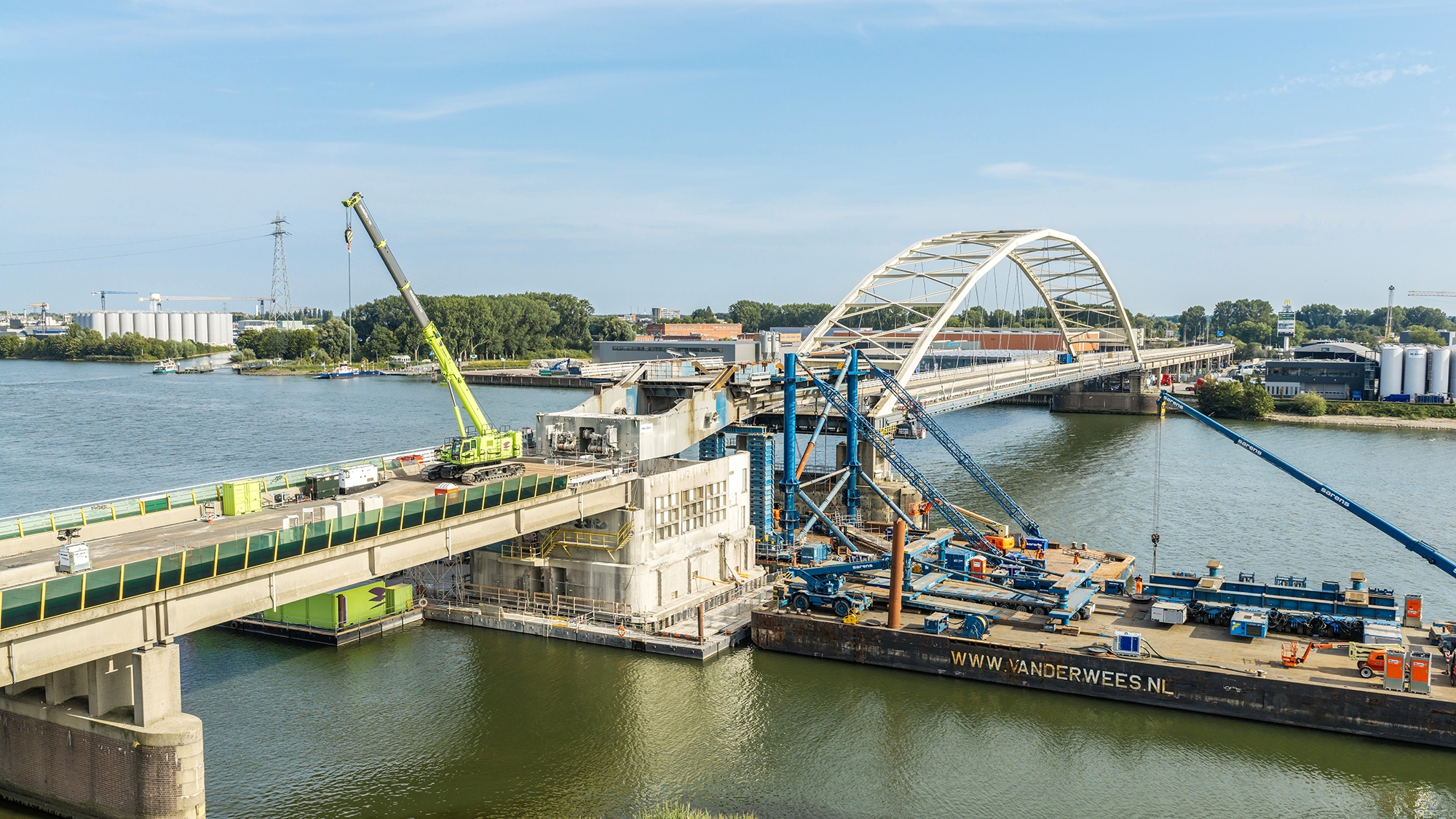
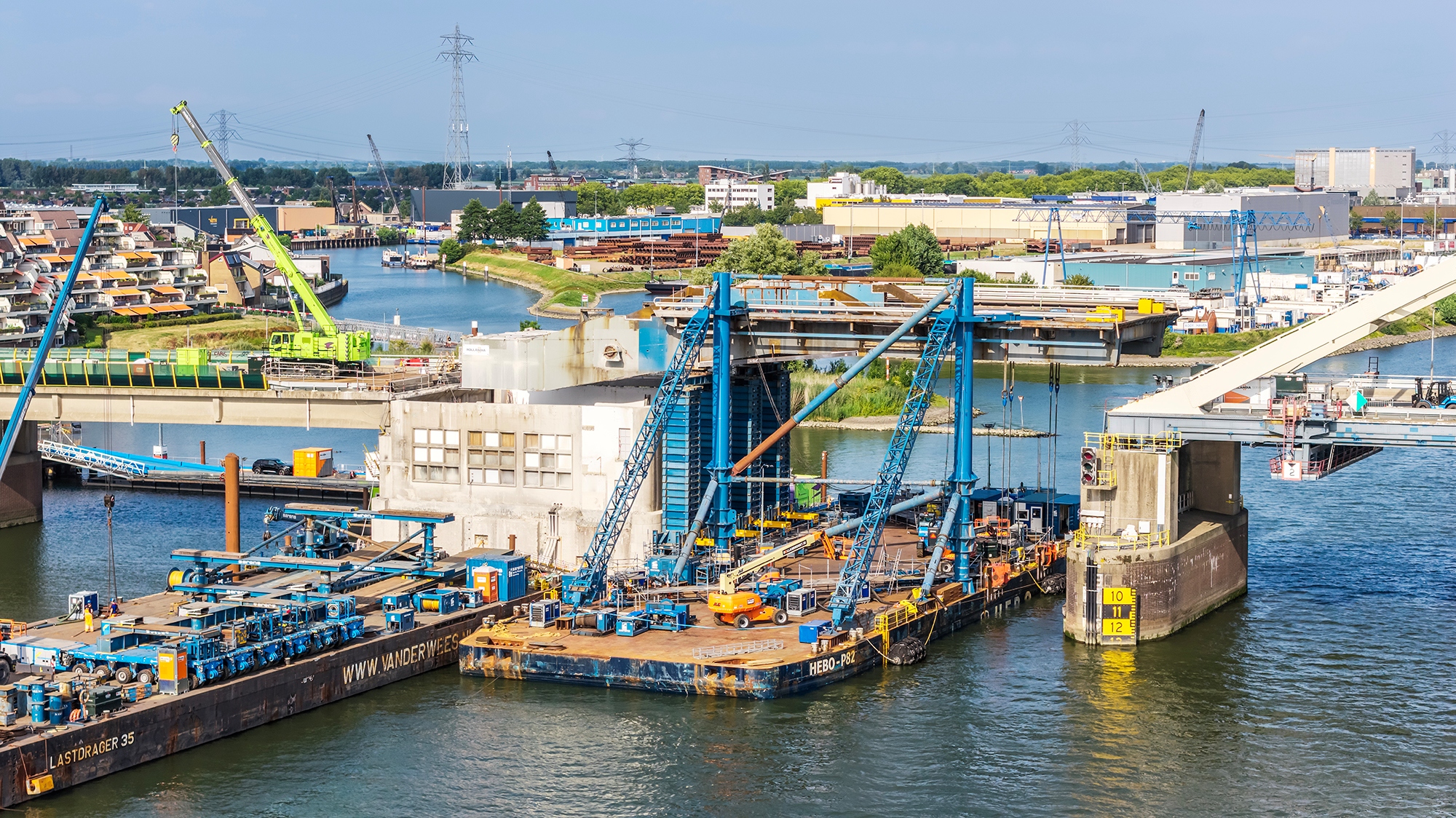
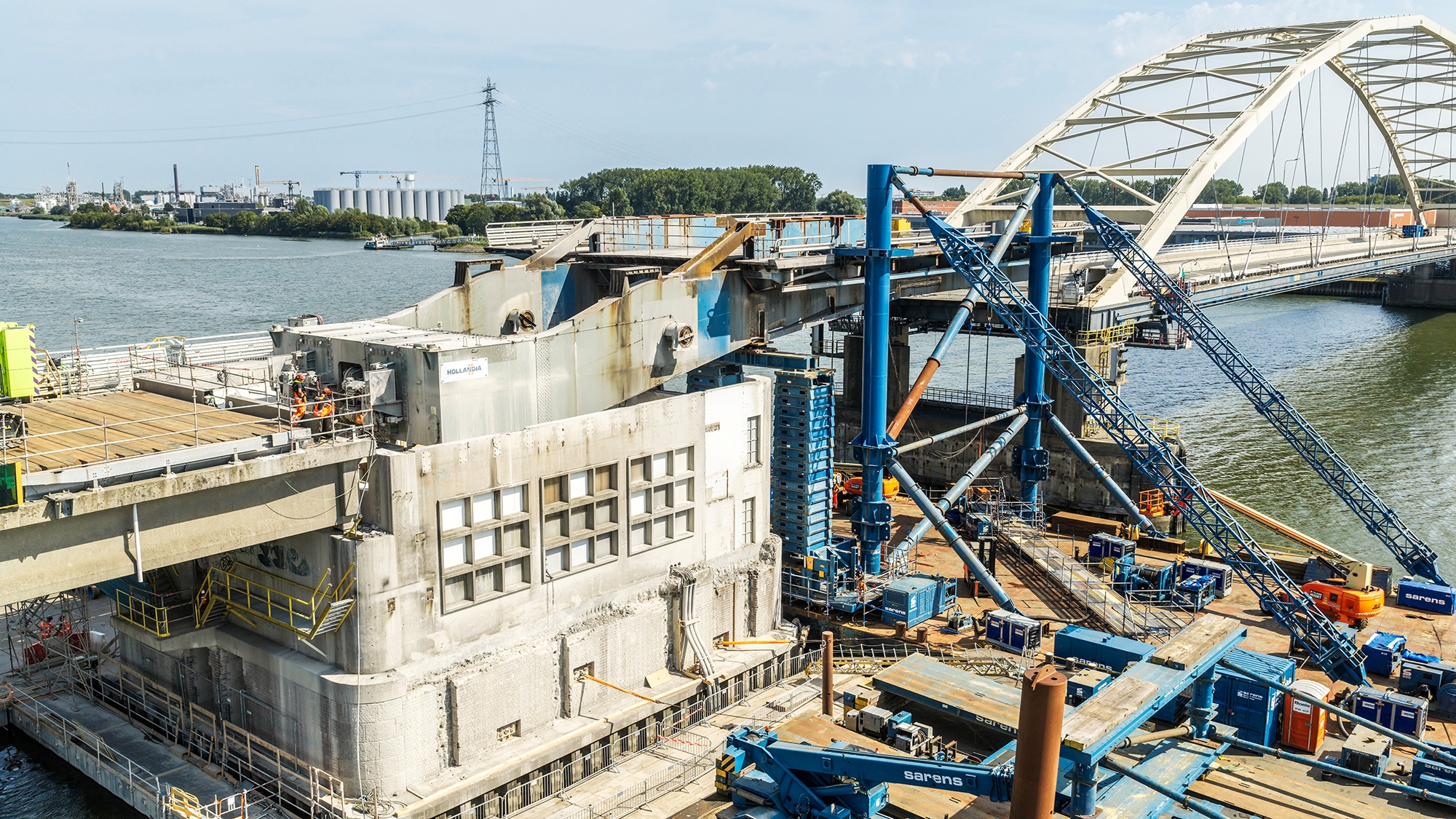
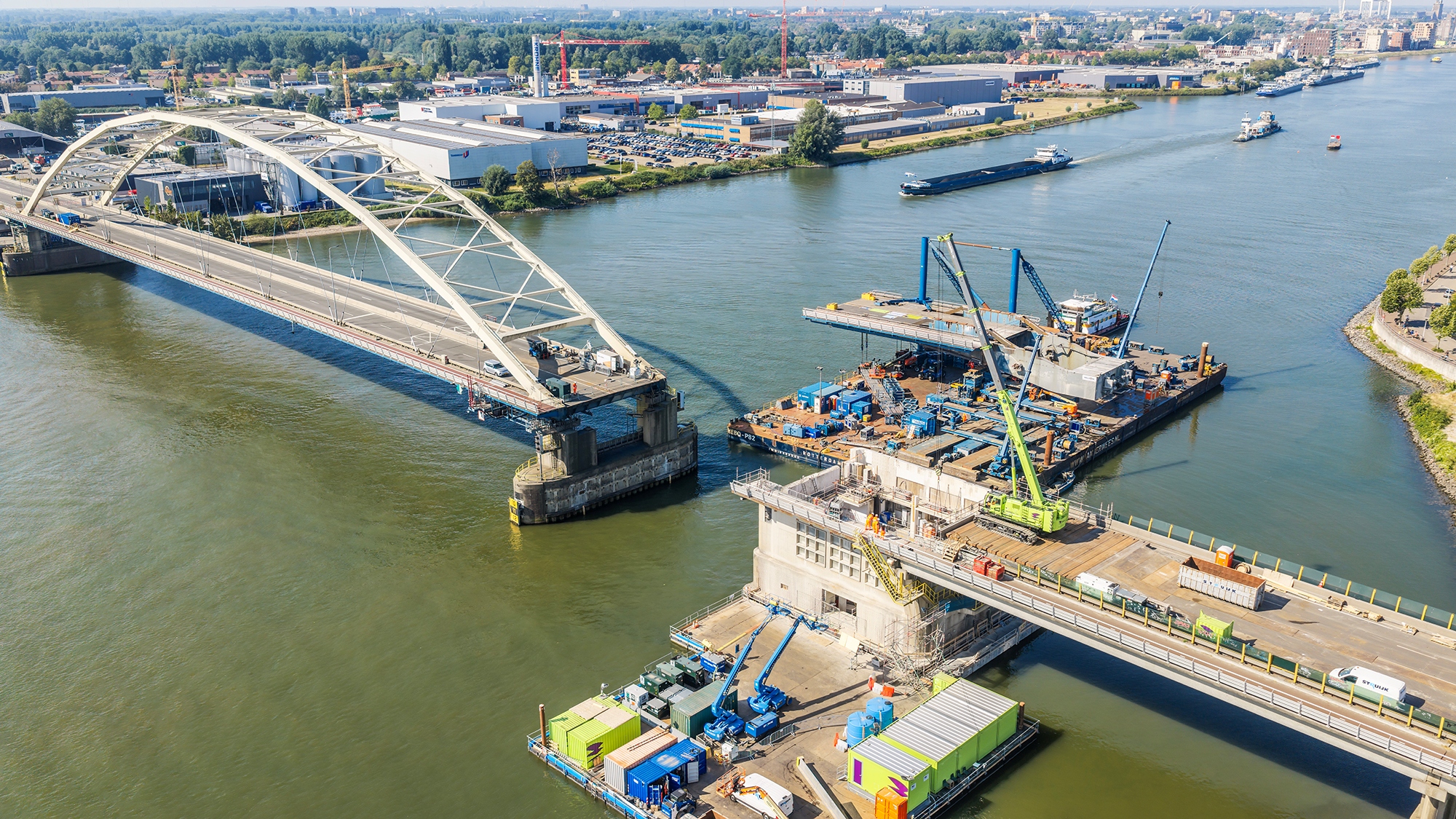
Normally, a bridge leaf is lifted out using floating cranes. However, due to the weight of this bridge leaf, the required floating cranes would have had a draught of approximately 6 metres. The water depth next to the bridge pit is only around 1.5 metres. We therefore chose to jack up the bridge leaf vertically and then move it out horizontally.
This method placed specific demands on the structural condition of the bridge leaf, as this had not been taken into account in the original bridge design. Prior to the operation, we reinforced the bridge leaf at critical points to ensure that it could withstand the unusual loads during dismantling.
The stability of the pontoons was also very important. The ballast box, the heaviest part of the bridge leaf, weighs approximately 450 tonnes and was suspended over the water outside the pontoon during the operation. Water-filled ballast tanks ensured that the entire set-up remained stable. To absorb the horizontal forces, the pontoon was also fitted with a vertical support frame. The bridge deck was secured to this frame using guides.
A challenging three-day operation
The entire operation took 72 hours and was carried out continuously: from positioning and connecting to jacking up, moving out, lowering and rotating the old bridge leaf.
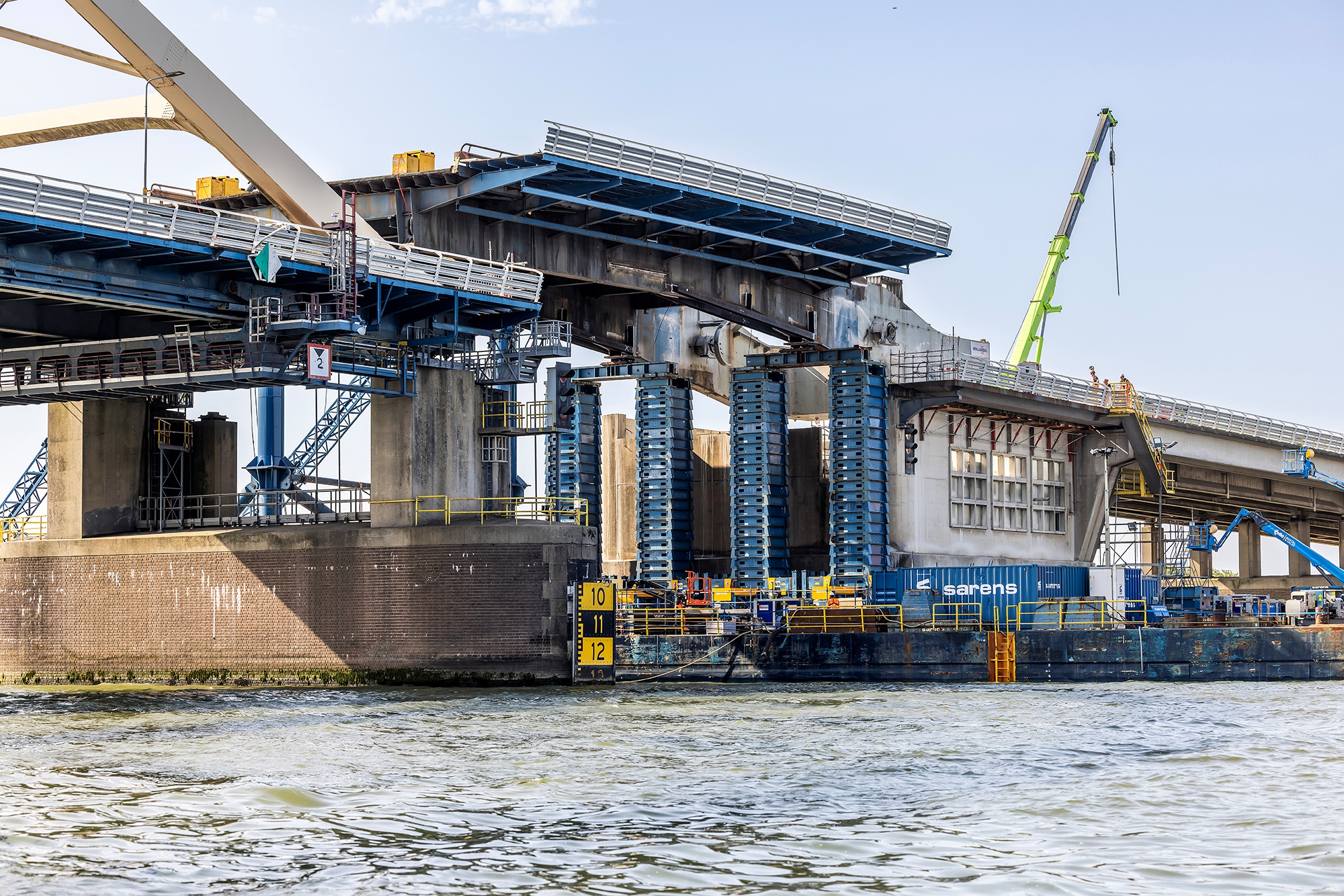
On Monday morning, Hollandia and Sarens began jacking up the bridge leaf vertically. As the ballast box was positioned approximately 20 metres outside the navigation channel during the operation, pushing upwards alone was not sufficient. While four large jacking towers pushed the bridge leaf upwards, two strand jacks simultaneously pulled the front downwards. Through this combination of pushing and pulling, the ballast box was raised centimetre by centimetre.
The bridge leaf was jacked up in 50-centimetre increments. After each step, the strand jacks made a compensating movement to bring the bridge deck back into a horizontal position. The balance of the entire set-up on the pontoon was continuously monitored. A tilt of just 5 centimetres was considered the limit for the entire set-up and pontoon.
To carry out the operation safely and prevent waves from disrupting the balance, shipping on the Beneden-Merwede was completely suspended for 24 hours.
The work progressed very smoothly. By the end of Monday afternoon, the required jacking height of 6.7 metres had been reached and the bridge leaf was completely clear of the bascule chamber.
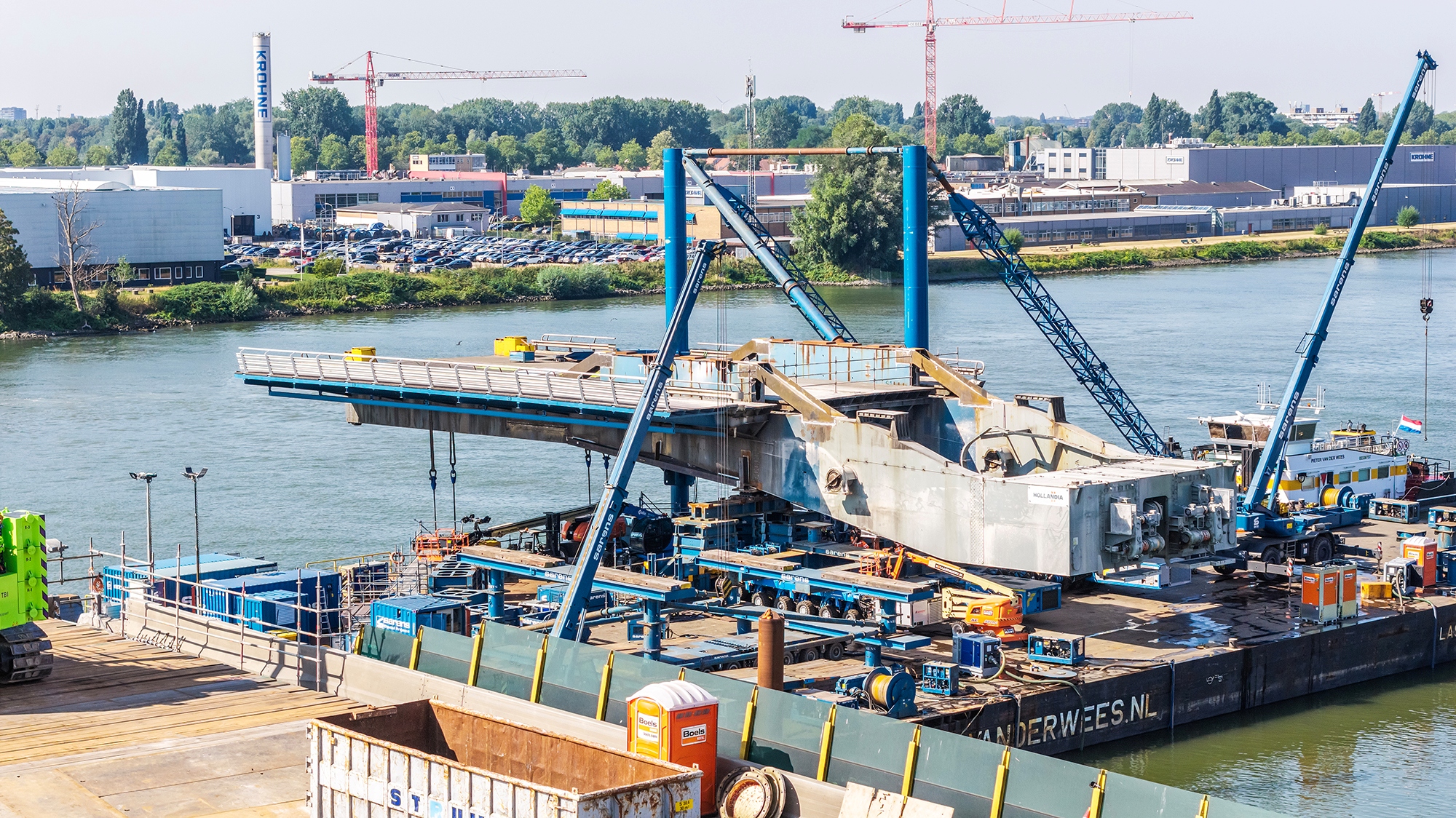
The bridge leaf was then moved sideways out of the bridge pit and lowered alongside it. Like the jacking operation, this was a delicate process in which stability was continuously and closely monitored. This step was also completed safely and well within the planned time.
Recycling
The bridge leaf was lowered onto SPMTs positioned on a transport pontoon. The bridge deck was then rotated by a quarter turn, so that it was positioned in the correct direction on the pontoon and ready for transport. The old bridge leaf will be transported to a processing facility in Vlaardingen, where it will be dismantled and prepared for recycling.
For safety reasons and to prevent large numbers of spectators from gathering to watch the operation, we chose not to publicise it in advance. Nevertheless, several interested spectators gathered on the banks of the Beneden-Merwede to watch the operation. They expressed their appreciation and admiration for the spectacle.
This provides a positive counterbalance to the significant disruption the project is causing for many road and waterway users in the region.
We are proud to have the expertise, close collaboration and professionalism required to bring these complex operations to a successful conclusion in a safe and controlled manner.
The next milestone is the lifting out of the quarter-circle gear rack from the bascule chamber. This operation is scheduled for Thursday, 6 August.
CMCP contractor consortium
Commissioned by Rijkswaterstaat, the Mobilis and Croonwolter&dros Papendrechtsebrug contractor consortium (CMCP) is replacing the bridge leaf, the mechanical operating equipment, and the operation, control and monitoring systems of the Papendrechtsebrug. A partnership has been formed with Hollandia Infra and Machinefabriek Rusthoven for the steel bridge leaf and the mechanical operating equipment.